Smart Glasses Driven by Enterprise Applications
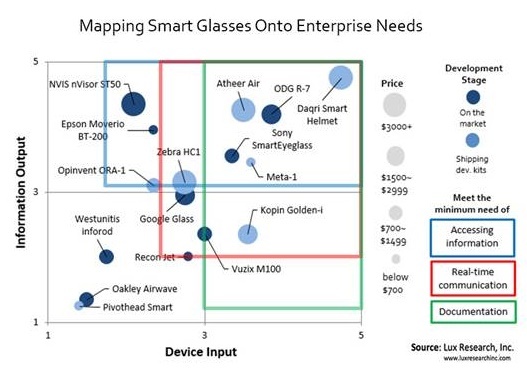
Smart glasses, once exemplified by the original but failed Google Glass, are seeing a resurgence, but are now driven by enterprise rather than consumer applications. Other rivals are topping Google in deploying smart glasses to provide "augmented reality" solutions for workers in factories, distribution centers, oilfields, and more, according to Lux Research.
Lux identified at least 70 enterprise deployments for the growingly powerful head-mounted displays. Most are still in pilot programs but use cases can broadly be classified into three core functions: accessing information, real-time communication, and documentation.
“As next-generation glasses such as Epson’s Moverio BT-2000 and Meta Pro emerge, the field will become even more competitive, ending a period of high premiums for hardware. Software and service will become the primary way to maintain margins,” said Tony Sun, Lux Research Analyst and lead author of the report titled, “Better Than Google Glass: Finding the Right Smart Glasses for Enterprise.”
“Apple’s impact on the market will also soon be visible, as it builds on the acquisition of Metaio, a leading augmented reality software developer,” he added.
Lux Research analysts evaluated over 70 enterprise deployments for augmented reality glasses, and compared leading products to identify the best for each use case. Among their findings:
- ODG R-7 is the best all-around device. Only five glasses meet minimum performance requirements across all three broad functions. Of them, Osterhout Design Group’s ODG R-7 stands out because it is the only one on the market that does not need a wired controller and meets industrial standards for hazardous environments.
- Sony’s SmartEyeglass stands out for customer service. SmartEyeglass is the top performer for use in customer service and quality control, fulfilling two of the three broad functions – information access and real-time communication – since it is light and small, and competitively priced. Sony’s product comes a close second for warehousing, assembly and installation, behind Meta-1, which is not yet on the market.
- Google Glass is in the game only for real-time communication. Google Glass is a truly viable option only in real-time communication applications such as online sales support. Even there it faces competitors like Vuzix, which is the best fit in this segment – light enough to be worn all day and meeting the need for live video streaming.
The report, titled “Better Than Google Glass: Finding the Right Smart Glasses for Enterprise,” is part of the Lux Research Wearable Electronics Intelligence and Electronic User Interfaces Intelligence services.