Beyond Bottlenecks: A Simulation-Based Path to Higher Capacity
Using INOSIM Insight to reveal hidden bottlenecks, validate engineering decisions, and accelerate capacity expansion
Sander Peer, INOSIM
Expanding biopharmaceutical manufacturing capacity is rarely as simple as adding equipment. As production volumes grow, hidden constraints in process equipment, buffer systems, cleaning operations, transfer routes, and schedules can limit throughput long before major assets reach their theoretical capacity. Understanding these interactions across the entire process is essential for sound engineering and investment decisions.
A global biopharmaceutical manufacturer faced this challenge in a multi-product facility for commercial biologics production. Several modifications had already been identified, but their actual effect on performance remained uncertain. Using discrete-event simulation with INOSIM Insight, the project team created a virtual model of the complete upstream and downstream process and evaluated improvement measures before implementation.
Looking beyond individual unit operations
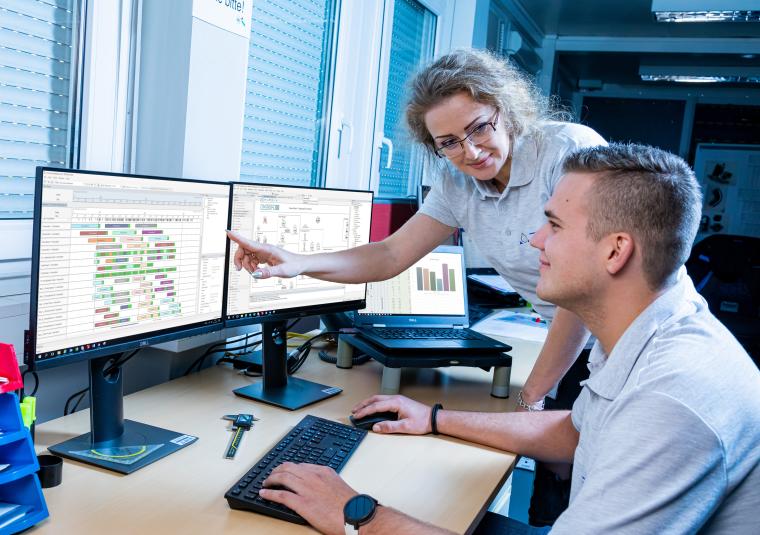
In complex biologics facilities, bottlenecks rarely originate from one piece of equipment. Capacity is shaped by the interaction of upstream and downstream operations, buffer preparation and storage, transfer routes, valve configurations, CIP and SIP activities, shared resources, and production scheduling. As facilities evolve, these dependencies become increasingly difficult to assess with conventional engineering methods alone.
The study initially focused on downstream bottlenecks. After the purification analysis, the model was expanded to cover the full production chain, including upstream operations. This integrated view allowed the team to compare current and future plant configurations under realistic conditions, test planned modifications, identify remaining constraints, optimize scheduling, and determine the achievable cadence for the facility as a whole.
The analysis confirmed that the proposed modifications eliminated several resource conflicts and improved process synchronization. Yet it also showed why isolated studies can be misleading: while the downstream model suggested a theoretical minimum cadence of about seven days, the integrated upstream-plus-downstream model demonstrated that the complete process could realistically achieve 8.8 days.
This analysis provided a reliable basis for decision-making, as it reflected all relevant process interactions rather than the performance of individual operations.
Measurable impact: 12% more capacity, 20% fewer CIP cycles
The integrated study quantified the operational and business value of the planned changes. It indicated an approximately 12% increase in manufacturing capacity, reduced the minimum production cadence from 10 days to 8.8 days, and cut CIP cycles by about 20%. At the same time, it validated proposed facility modifications before implementation and revealed the remaining constraints that would limit further expansion.
Instead of relying on trial and error on the shop floor, engineers could assess alternatives in a virtual environment and direct future investment toward the measures with the greatest operational effect. Simulation turned assumptions into measurable results—and helped avoid spending on changes that would not improve end-to-end performance.

A reusable basis for better decisions
The value of the model extends beyond the original bottleneck study. Once established, it can support capacity expansion, scenario comparisons, campaign planning, resource optimization, capital-project evaluation, and future process changes. New ideas can be tested before they are implemented, reducing technical risk and investment uncertainty while preserving a consistent view of the facility.
As biologics manufacturing becomes more complex, intuition and isolated calculations are no longer enough. Process simulation provides a data-driven way to understand interactions, uncover hidden bottlenecks, and validate improvements before implementation. The result is greater confidence in investment decisions, faster execution, and a clearer path toward sustainable capacity growth.

Peer Sander
Head of Technical Affairs, INOSIM GmbH
© INOSIM