

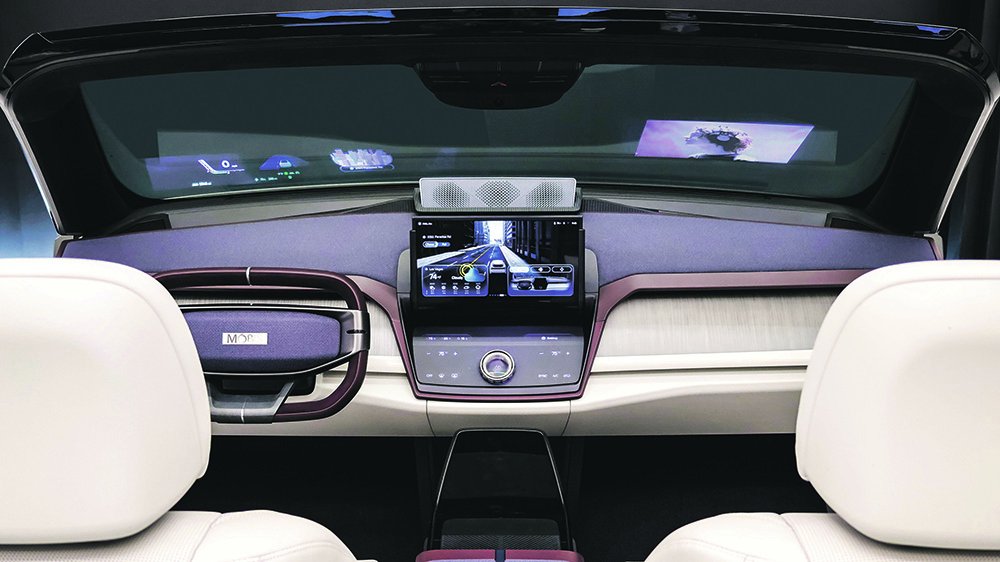
The automotive industry is continuing its transformation at rapid speed, fueled by trends in electrification, circularity, sustainability and digitalization. By joining forces, businesses can co-create solutions that enable far more successful responses to this change than any company could develop alone. tesa is using these opportunities to embed partnerships into the heart of its innovation activities - to explore high-impact solutions that take advantage of this transformation together with collaborators from every step in the value chain, helping customers navigate complexity and stay competitive.
content:
- Collaborating in a changing automotive landscape
- Enabling recyclability, repairability and circularity through precision bonding for advanced automotive display systems
- New infotainment technologies: enabling scalable holography for a better driving experience
- Boosting efficiency for vehicle body manufacturing
- A collaborative model for innovation
- David Caro
Collaborating in a changing automotive landscape
The global automotive industry is undergoing change at exceptional speed and scale.
Consumer expectations, corporate sustainability targets and rising regulations are accelerating the transition to low-emission electrified drivetrains, while connected and digital features are enabling futuristic vehicle designs.
This combination opens up opportunities for bold new design and engineering concepts. By combining expertise from across the value chain, businesses can address these opportunities faster and with greater technical depth. A recent study by the Porsche company MHP showed that 87% of global OEMs expect partnerships to play a bigger role by 2028, and 76% of US OEMs use partnerships to drive innovation.
At tesa, automotive specialists are focusing on co-innovation by working with partners and customers with complementary technologies and application expertise. In this model, suppliers are not only delivering components; they help shape solutions from the earliest development stages. The collaboration models involved vary by application. They include co-development and licensing activities, as well as coordinated go-to-market approaches. The company contributes a deep knowledge of materials, processes, and automation to these projects, enabling customers to accelerate their own development cycles and bring solutions to market faster. Specifically, its adhesive technologies act as enabling layers by forming reliable bonds, achieving precise assembly, and supporting the rework, repair, and recycling of components across the vehicle life cycle.
Continue with login
No account yet?
Register now for free and get full access to all exclusive articles from chemanager-online.com. With our newsletter we regularly send you top news from the chemistry industry as well as the latest e-issue.
RegisterCompany
Tesa SEHugo-Kirchberg-Straße 1
22848 Norderstedt
Germany



most read

20 Years of CHEManager International
Incredible but true: CHEManager International is celebrating its 20th anniversary!
ISPE Good Practice Guide: Validation 4.0
The Validation 4.0 Guide provides a comprehensive approach to ensuring product quality and patient safety throughout a pharmaceutical product's lifecycle.

Pharma 4.0—the Key Enabler for Successful Digital Transformation in Pharma
Part 3: Seven Theses for successful Digitalization in Pharma

Lead or Lag: Europe’s AI Materials Race
How AI and Robotics are reshaping the race for materials discovery.

Relocation of Chemicals Production Footprint in Full Swing
A new Horváth study based on interviews with CxOs of Europe’s top chemical corporations reveals: The majority of board members expects no or only weak growth for the current year.