Spark e-Fuels – Reimagining How Aviation is Fuelled
German start-up Spark e-Fuels is helping the aviation industry move toward more sustainable flight by developing a new, energy-efficient and cost-competitive method to produce synthetic aviation fuels.
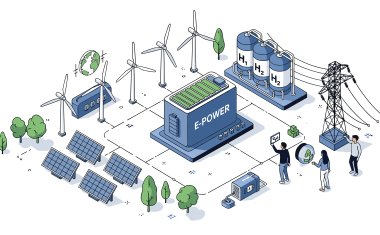
The company’s technology uses renewable electricity directly from off-grid locations, making e-fuel production more efficient and affordable while avoiding the need to build additional power and distribution infrastructure. Spark’s technology is designed to work flexibly with changing energy supply from sources like wind and solar, adjusting fuel production dynamically as electricity availability rises or falls. Therewith, the system reduces the need for large, highly-expensive hydrogen storage and improves overall efficiency—supporting scalable, cost-effective, and climate-friendly fuel solutions for aviation.
For these reasons, Spark e-Fuels has been chosen as one of the ISC3 Innovation Challenge finalists 2025 and is featured by the International Sustainable Chemistry Collaborative Centre as the ISC3 Start-up of the Month for November 2025.
Their core innovation lies in their first conversion step, using the reverse water-gas shift (RWGS) reaction to convert carbon dioxide and water into a syngas, a mixture of hydrogen and carbon monoxide. Their process operates at lower temperatures and achieves much higher CO₂-to-CO conversion than conventional processes.
In the second step, carbon monoxide and hydrogen are converted into liquid fuels via the Fischer-Tropsch (FT) reaction. By tightly integrating these synthesis steps, Spark enables efficient, flexible fuel production that adjusts dynamically to the available hydrogen supply.
Using captured CO₂ and green hydrogen, this approach offers a realistic, net-zero pathway for producing e-fuels, promoting more sustainable industrial practices in aviation and chemical sectors. The lower costs achieved further support scalability and accessibility, aiming to transform hard-to-decarbonize sectors like aviation with modern, clean energy solutions.
The whole success story of the ISC3 Start-up of the Month in January 2026 is currently told by the ISC3 on its website at Spark e-Fuels (isc3.org).
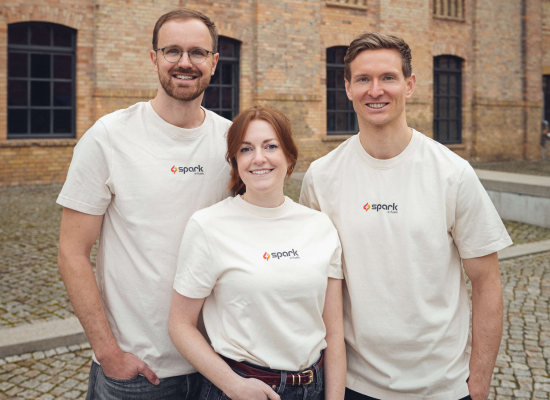
Three questions for Mathias Bösl (Co-founder & CEO of Spark e-Fuels):
What led to your solution in Sustainable Chemistry?
Mathias Bösl: Sustainability has always driven my work. After working in nuclear fusion and strategy consulting, I wanted to turn deep theoretical knowledge into real-world impact. Unlike many startups that begin with a technology and then search for a market, we started by identifying a market problem. This led us to a customer-driven approach of building a demand-responsive e-fuel solution that can directly connect with cheap, renewable electricity. As no suitable load-flexible technology existed, we had to develop one ourselves.
What does being chosen as ISC3 Innovation Challenge finalist and ISC3 Start-up of the Month mean to you?
M. Bösl: It’s a great recognition and gives our start-up valuable visibility. We appreciate ISC3’s holistic approach and its focus on the full spectrum of Sustainable Chemistry. The Investor Forum was especially valuable for connecting with other start-ups, the wider ecosystem, and investors. Overall, the collaboration with ISC3 has been very worthwhile, and we look forward to further engaging with this network.
What’s next up at Spark e-Fuels?
M. Bösl: We’re currently building a pilot plant scheduled to become operational in the coming months, a key milestone to validate our technology at scale. Next, we plan to develop a demonstrator by securing partners, a suitable location, and funding. In the long term, our goal is to scale up production and supply our technology to e-fuel projects worldwide, helping make sustainable aviation fuels broadly accessible.
Company