Second German Fluegas Capture Unit to use BASF Process
Complementing a deal recently signed with Germany’s Messer industrial gases group for a carbon dioxide recovery plant in Austria, BASF has announced that a new flue gas recovery technology based on its OASE blue process will be used by a new joint venture of industrial gases and engineering group Linde and cement producer Heidelberg Materials.
The large scale carbon capture and liquefaction facility to be built by the JV called Capture-to-Use (CAP2U) at Heidelberg’s Lengfurt site in Germany will be among the first in the cement industry to employ industrial-scale carbon capture and utilization (CCU). It will also be the third industrial-scale capture facility globally to use the OASE blue process.
The recovery process developed jointly by BASF, Linde and Heidelberg Materials leverages the chemical giant’s patented OASE aerozone design, which reduces dust and aerosol-induced emissions from the gas flow of industrial facilities.
Compared to conventional technologies, OASE offers high efficiency in gas treatment and thus makes important contributions to conserving resources and reducing emissions by saving energy, BASF said.
Once in operation — no start-up date has been disclosed — the Lengfurt facility is envisioned to capture, liquefy and purify around 70,000 t of CO₂ annually. Most of the resulting liquid CO₂ output will be marketed by Linde as feedstock for the chemicals and food & beverage end-markets.
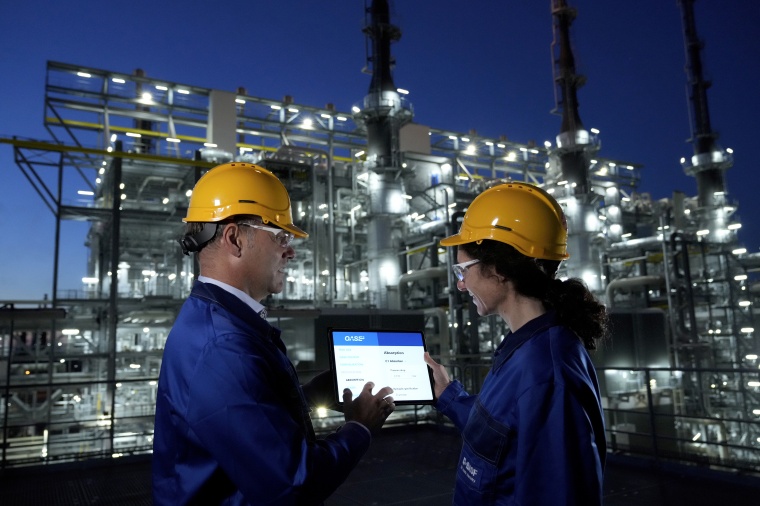
"For many of Linde’s customers in the heavy industrial sector, improving the environmental performance of their operations is a priority," said Sean Durbin executive vice president EMEA of the formerly Germany-based, now Ireland-domiciled, Linde. Considering the current market constraints, he added that it also will be a welcome new source of CO₂ that will help ensure supply for the merchant market.
Andreas Northemann, head of BASF’s global Gas Treatment business, said the carbon capture and use unit operation has the potential to become a showcase project for a sector with hard-to-abate emissions.
According to a study by the Oxford Institute for Energy Studies, the cement industry is responsible for around 7% of global industrial greenhouse gas emissions, as its production employs a calcination process to treat calcium carbonate. In contrast to other energy-intensive industries, emissions caused by fuel consumption do not constitute the major part in total emissions, making carbon capture and utilization/storage (CCUS) essential, the study says.
Author: dede Williams, Freelance Journalist