Chemicals’ 2026 Rebound: Strong Returns, Narrow Demand
McKinsey finds chemicals shareholder returns beat the broader market in 2026 (14% vs. 10%), driven by electronics and data centers, while Middle East disruption and weak core demand keep the recovery uneven.
McKinsey’s latest Chemical Insights Quarterly shows an industry that is beating the market but recovering unevenly. Chemicals shareholder returns rose 14% through mid-September 2026, against 10% for the broader world index. Almost all of that gain came in January and February, and returns have been flat since. Companies serving electronics and data centers are the main driver. Their returns are about 48% this year, and their valuation multiples have risen by four to five turns.
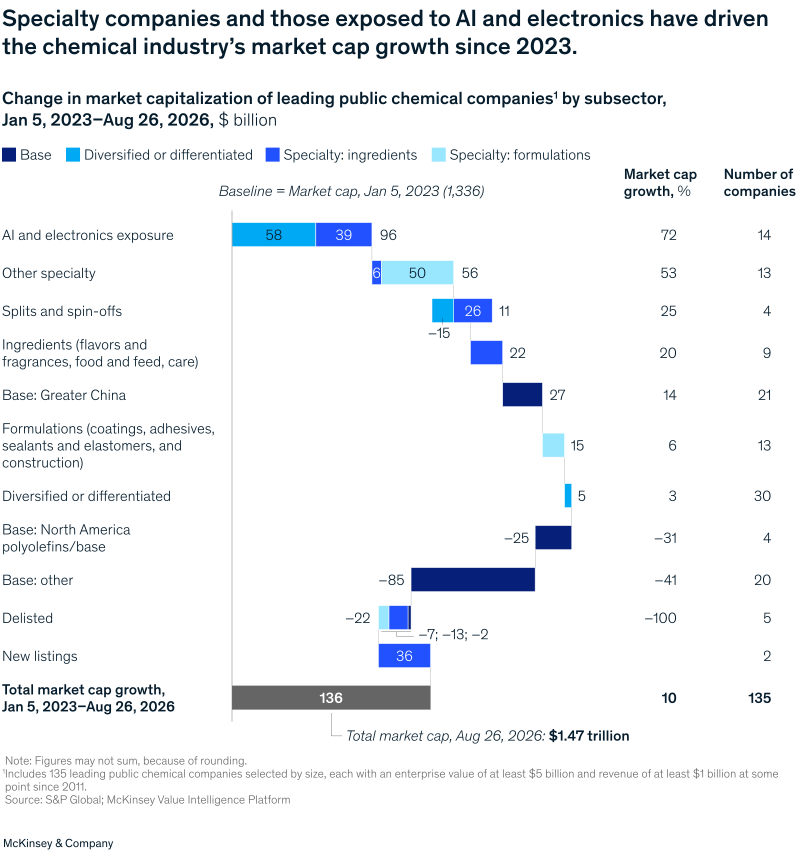
The Middle East supply disruption continues, but its effect on petrochemical prices has been smaller than expected. Prices have mostly tracked higher feedstock costs. China’s lower import needs, with net polyethylene imports down by about 6 million tons a year, have softened the impact in Asia. New ethylene capacity of roughly 8 million tons also came online between April and July. Profitability is rebounding, and analysts expect petrochemical EBITDA among the largest public players to nearly double in 2026. Capital spending is falling, which should support free cash flow through 2027. Large-scale M&A is also holding up, with about 20 deals above $1 billion already in 2026, with several above $10 billion.
Demand tells a more mixed story. Electronic chemicals volumes are growing 15 to 20%, and semiconductor sales are up sharply. Specialty segments such as personal care and life sciences are growing moderately. Construction, packaging, and automotive remain weak. With a broad demand recovery outside Asia no longer assumed, companies are shifting from cost-cutting to structural moves, including portfolio changes, consolidation, and asset rationalization. McKinsey will be watching how firms use their recovering cash flow and whether growth spreads beyond electronics.