Soccer World Cup: Materials in the Spotlight
The 2026 Soccer World Cup in the United States, Canada, and Mexico demonstrates that materials such as plastics and adhesives have revolutionized the sport and are contributing to greater functionality and sustainability.
Michael Reubold, CHEManager
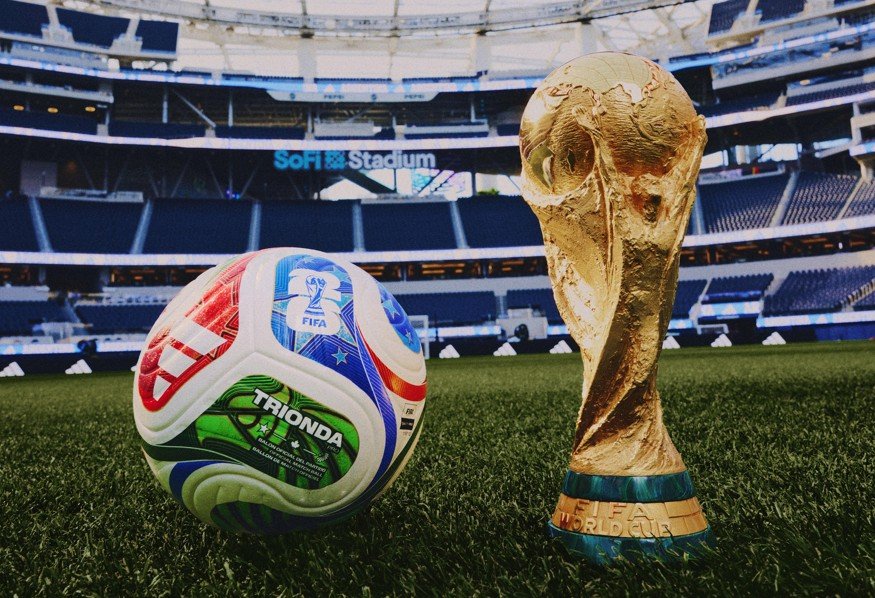
One ball, two teams, one field: Soccer may seem simple, but in reality, the modern game is a high-performance system. In modern soccer, materials play a crucial role. They help enable speed, control, comfort, durability, and performance—from equipment and apparel to infrastructure and digital connectivity.
The Germany-based materials manufacturer Covestro is shining a spotlight on this “Material Effect” behind soccer: the often-invisible contribution of materials science to how the sport is played, experienced, and connected worldwide. Covestro and many other chemical companies are working together with users such as sporting goods manufacturers and architectural firms on advanced material solutions for game equipment, gear, and sports facilities.
Precision and Performance
Modern soccer has become faster, more precise, and more connected. Players sprint more, press more intensely, and change direction more quickly. Behind this development are better training methods and data analysis, but also materials that help make high performance more reliable.
The soccer ball itself is a good example. Modern balls utilize advanced materials, carefully engineered surfaces, and precise construction methods. They ensure consistent weight, stable shape, reliable bounce, and predictable flight characteristics—even under challenging weather conditions. Compared to traditional leather balls, today’s soccer balls are designed for greater reliability and more predictable performance. And some of them are even digital.
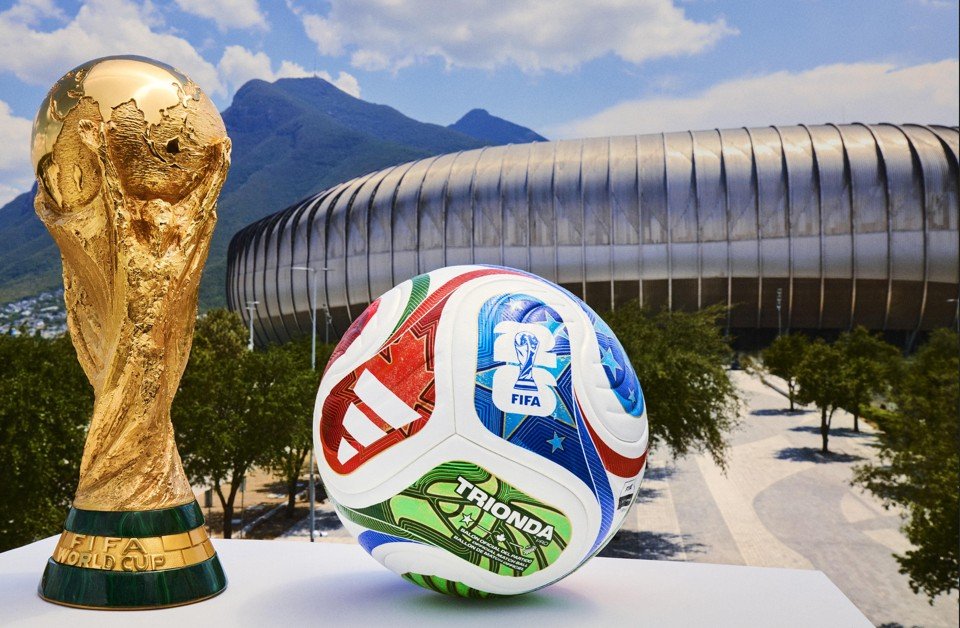
Trionda—the official match ball of the 2026 World Cup—pays homage to the nations hosting the tournament: Canada, Mexico, and the United States. Designed for peak performance, the ball is based on a completely new four-panel construction, whose fluid design language echoes the waves depicted in the ball’s official name. Each panel features the national colors of red, blue, and green, which converge in the shape of a triangle at the center of the panel, symbolizing that three nations are co-hosting the tournament for the first time.
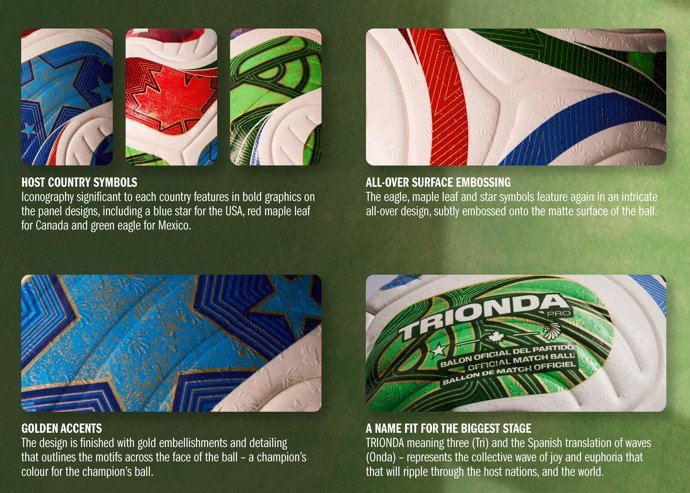
“Trionda” – The Official Match Ball of the 2026 Soccer World Cup
TPU (thermoplastic polyurethane) is one of the most important materials used in high-quality soccer balls today, including the official World Cup match ball from Adidas. TPU is primarily used for the outer shell and influences nearly all of the ball’s performance characteristics.
TPU provides soccer balls with key properties such as abrasion resistance, water resistance, and flight and playing characteristics. The material is resistant to friction and mechanical stress. As a result, professional and training balls last longer, even on artificial turf or hard surfaces. Modern TPU coatings absorb significantly less water than older leather balls. The ball’s weight therefore remains relatively constant even in the rain. TPU can be precisely textured and embossed. Surface textures improve aerodynamics, ball control, as well as spin and grip in wet conditions.
TPU panels can be welded together instead of sewn. This results in rounder balls and more consistent flight paths, and also reduces water absorption through the seams. TPU combines flexibility with stability. As a result, the ball feels soft enough for control but retains its shape during hard shots.
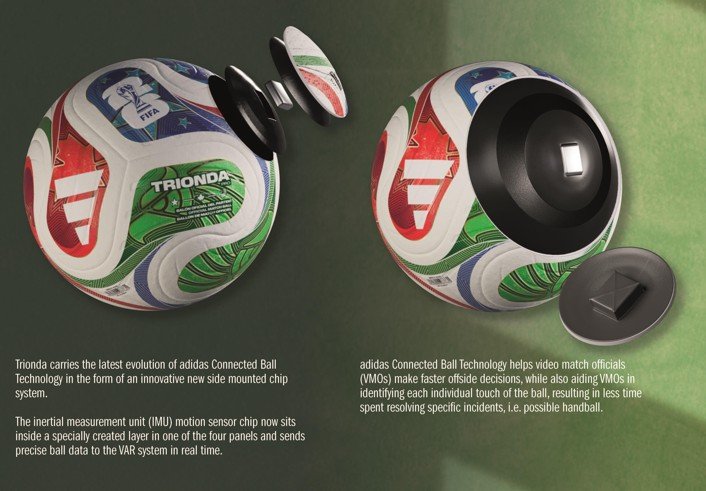
Trionda game balls are also equipped with the latest version of Connected Ball Technology—in the form of an innovative chip system mounted on the side. The 500-Hz motion sensor chip of the inertial measurement unit is now located in a specially developed layer within one of the four panels, rather than as a centrally mounted system secured by a suspension, as was previously the case. Counterweights in the three remaining panels continue to ensure flight stability and balance.
The technology provides unprecedented insights into every movement of the ball and transmits precise ball data in real time to the Video Assistant Referee (VAR) system. In combination with player position data and the use of artificial intelligence, it helps referees make faster offside decisions.
The Era of Synthetic Materials
In the 1960s, as Pelé captivated the soccer world, synthetic materials began to make their way into the sport. The 1970s and 1980s brought further innovations. The balls became lighter and more aerodynamic, and soccer became more technological.
The breakthrough came at the 1986 World Cup in Mexico with the ‘Azteca México,’ the first match ball made entirely of synthetic materials. This ball, whose synthetic leather consisted of polyurethane (PU) and polyvinyl chloride (PVC), ushered in a new era, as it enabled a more precise and faster game.
This trend continued in the 1990s and 2000s. The 2006 World Cup in Germany brought not only a “summer fairy tale” but also a unique ball, crafted with minimal seams and innovative materials to ensure perfect roundness and consistent performance.
Whereas tournament balls used to be sewn, today’s balls—made of thermoplastic polyurethane (TPU)—are bonded in layers. For example, an adhesive layer bonds the textile substrate of the ball’s outer shell to the upper layers. On top of this lies an approximately 1 mm thick layer of polyurethane foam consisting of millions of gas-filled microspheres. The outer shell consists of two polyurethane layers and an intermediate layer of EPDM rubber (ethylene-propylene-diene monomer), which ensure resistance to external influences and abrasion, as well as the ball’s high elasticity, and support optimal bounce behavior during play.
Thanks to innovative material technologies, soccer balls have gained increasingly better playing and flight characteristics since the beginning of modern ball development, revolutionizing the sport.
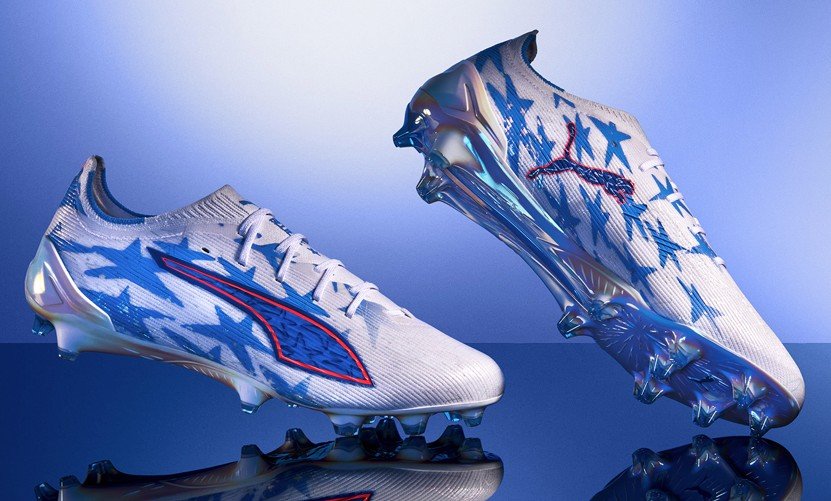
High-tech materials are also used in equipment
Innovative high-tech materials dominate both the national teams’ jerseys and the players’ soccer cleats, and these materials increasingly incorporate sustainability considerations such as the use of recycled materials and recyclability. Modern manufacturing techniques such as 3D printing are also increasingly finding their way into production. And in the media age, iconic designs are meant to grab attention.
Over the past few decades, soccer cleats have undergone fundamental changes that go beyond just their color schemes. Modern soccer cleats are highly complex multi-material composite systems in which plastics play a central role in performance, weight, and durability. Lightweight uppers, flexible structures, and high-performance sole plates support grip, acceleration, agility, and ball control. The contact between player, turf, and ball has become a highly sophisticated interface.
The most important types of plastic used in a modern soccer shoe are TPU (thermoplastic polyurethane) as a key material for, among other things, the sole, studs, and structure; PU (polyurethane) as the upper material (synthetic leather); PEBA (polyether block amide), a thermoplastic elastomer, or PA (polyamide) for high-performance soles, EVA (ethylene vinyl acetate) or PU foam as cushioning elements, and polyester or polyamide for textile components.
Current trends include recycled polymers (rPET, bio-based TPU/PEBA), single-material approaches for improved recyclability, additive manufacturing (3D printing) with TPU, and the integration of functional elements directly into the polymer design (grip, flex zones).
Puma’s latest shoe model combines functionality and individuality. It features a redesigned upper made of technical mesh paired with the Powertape support system. A special synthetic outsole is designed to enable lightning-fast acceleration, multidirectional traction thanks to the FastTrax stud design, and precise finishes through 3D-structured shooting zones.
Sportswear also plays a role. Lightweight, breathable, and durable fabrics can help regulate moisture and improve comfort during intense physical activity. Today’s soccer jerseys are made of high-tech polymer-based fabrics. In contrast to soccer cleats, a few carefully selected types of synthetic materials dominate here, such as PET (polyethylene terephthalate) as the primary fabric material, as well as spandex (PU) for stretch zones, polyamide for strength, or PU/TPU/silicone for functional add-ons. Current material trends focus on sustainability (e.g., 100% recycled polyester systems, monomaterial designs) and functionality (breathability, moisture management). Covestro’s water-based polyurethane technology enables high-performance textile coatings that can offer softness, water resistance, and long-lasting performance while supporting more sustainable manufacturing approaches.
Plastics in Stadium Construction
Stadiums have also benefited from modern materials, particularly in cladding and the often highly complex load-bearing roof structures that have become standard in new arenas. Modern stadium roofs are based on a few key polymers and consist of membrane- or panel-based high-performance plastic systems. Premium membrane roofs consist of PTFE-coated fiberglass or PVC-coated polyester fabric, or films made of ETFE (ethylene tetrafluoroethylene). Such functional coatings provide, for example, a self-cleaning effect or adaptive transparency depending on the angle of light. Hybrid roofs are usually plastic panels made of PC (polycarbonate) or PMMA (polymethyl methacrylate) mounted on a steel structure.
Today, spectators usually sit on sturdy, pigment-colored plastic seat shells made of polyolefins, which are weather-resistant and flame-retardant due to special chemicals. In some stadiums or grandstand areas, the seats are also coated, making them more comfortable, even more fire-resistant, water-repellent, or slower to heat up in the sun. Plastics also play a key role in modern stadium technology, such as electronic displays and video walls, just as they do throughout the information and communication technology sector.
For the 2026 World Cup, attention is also turning to one of the most famous and historic arenas in international soccer: the legendary Azteca Stadium in Mexico City. In the very place where Pelé made history, Diego Maradona scored a goal with the “Hand of God,” and millions of fans experienced unforgettable soccer moments. Fischer fastening technology was used as part of modernization efforts.
When people hear the name Fischer, many first think of the famous anchors, but the types and applications of the fastening solutions are diverse. Among other things, they are used to secure HVAC systems, facade elements, technical infrastructure, reinforcement connections, and stadium seats. Not only do high-performance plastics play a role here, but also construction chemical solutions such as injection mortar.
The Munich Olympic Stadium demonstrates what modern fastening technology looks like today. There, intelligent Fischer SensorBolts continuously monitor the safety-critical fastening points of the visitor platform in the roof structure in real time. The project illustrates how traditional fastening solutions are increasingly being integrated with digital technologies.
One unique aspect of the 2026 World Cup concerns the playing fields. FIFA stipulates that all World Cup matches must be played on natural grass. Many of the stadiums in the U.S. (especially NFL arenas) normally have artificial turf. For the World Cup, however, these fields were temporarily converted entirely to natural grass. That said, some playing fields consist of hybrid turf with approximately 95% real grass, reinforced by integrated synthetic fibers. Synthetic turf fibers, known as filaments, are typically polyolefin yarns that are increasingly being made from bio-based or recycled polymers. Dyed and made weather-resistant and durable with plastic additives such as light stabilizers, they can be returned to the recycling cycle at the end of their useful life. Thus, artificial turf fields are not only robust and low-maintenance but also sustainable.
You can find more articles on soccer and chemistry here.