Umicore Develops Catalyst within EuroBioRef Project
The EuroBioRef project (European Multilevel Integrated Biorefinery Design for Sustainable Biomass Processing) was a four year project coordinated by CNRS, France. Launched on March 1st, 2010 and ending on February 28th, 2014, the project was supported by a €23 million grant from the European Union Seventh Framework Program (FP7).
EuroBioRef had the unique capability of dealing with the entire process of transformation of biomass from non-edible crops production to final commercial products. It involved 29 partners (industry, SMEs, academics) from 15 different countries in a highly collaborative network, including crop production, biomass pre-treatment, fermentation and enzymatic processes, catalytic processes, thermochemical processes, assessed by a life cycle analysis and an economic evaluation of the whole development chain. With this strategy to develop next generation biorefineries, the project generated a generous amount of results with an important impact on the European bioeconomy, including new energy & new chemicals production strategies.
The development and implementation of biorefinery processes is of crucial importance for building a bio-based economy. Although most of the existing biorefinery concepts use limited feedstock and technologies, generally focus on producing biofuels that use massive economies of scale at one dedicated site to achieve higher performance and optimize along few product lines (e.g. liquid biofuels and electricity, basic biochemicals plus ethanol or biodiesel), EuroBioRef´s biorefinery approach demonstrated the technical and economic viability of the synergy of the biomass agro industry with a wide range of chemical, biochemical and thermochemical conversion processes and technologies that will be combined to optimize production routes of high added-value bio aviation fuels, chemicals and polymers.
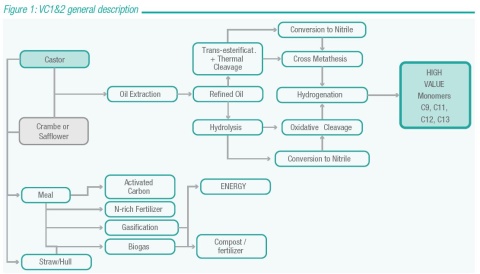
This ambitious project was divided in six value chains, each of them evaluating the possibility of transforming a specific biomass feedstock into a series of chemical products. Umicore contributed to value chains 1 and 2, dealing with the transformation of castor, crambe or safflower oil into polymers. The final application targets the polyamide market and will compete with existing polymers: PA12 (made of butadiene), PA11 and PA10 (made of castor oil).
Umicore´s contribution was the development and up-scaling of the metathesis catalyst used in the transformation of the oleochemicals into C9 to C13 monomers, to be subsequently polymerized in polyamides. It also allowed the company to develop a long term partnership with one their most important customers, involving interaction between various levels of management, and experts in production, R&D, technology and intellectual property.
The results of the project were presented during a final series of conferences in Brussels on February 11th-12th, 2014. Umicore is now looking forward to the progress of the industrialization phase. For more information, please click here.