

Trusted Evidence in the Age of AI
Josh Jarrett, Senior Vice President & General Manager of Applied Research Intelligence, Wiley
The pharmaceutical industry’s relationship with AI has entered a more demanding phase in just a year’s time, moving past the hype cycle and into something more demanding: the implementation cycle. This is where the real work happens and where the difference between well-built and poorly-built AI becomes consequential. In pharmaceutical R&D, medical affairs, and clinical decision-making, the stakes of getting it wrong are not abstract. They will show up in concrete and impactful ways.
I spend my days at the intersection of scientific publishing and the AI ecosystem, working with pharmaceutical companies, biotech startups, AI platform builders, and clinical technology providers on how the world’s peer-reviewed research gets put to work in these new systems. What I see across that landscape is a field that is accelerating rapidly, but with uneven outputs.
The organizations that will deliver the most scientific advancement are the ones that recognize that the quality of evidence underneath an AI system is every bit as important as the sophistication of the model on top.
What Makes AI Trustworthy in Pharmaceutical R&D?
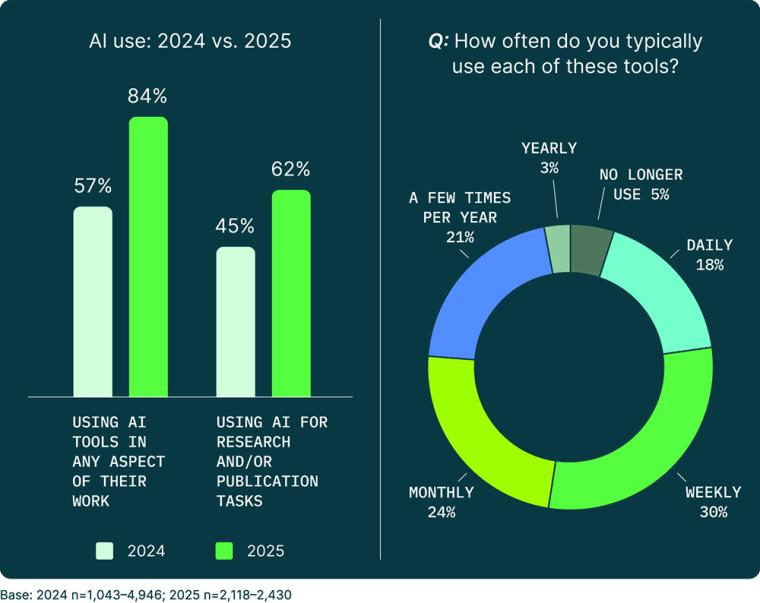
At Wiley, we recently surveyed thousands of researchers on AI adoption. A year and a half ago, 57 percent reported using AI in their work. That number is now 84 percent. The striking detail is that of those 84 percent, the vast majority cited serious concerns about the quality, accuracy, and trustworthiness of the outputs they were relying on. It’s likely that they’re using these tools anyway because the productivity gains are too compelling to ignore, but they don’t fully trust what’s coming back. In fact, their concerns have increased, not decreased over the past year.
For general-purpose applications, that’s a manageable tension. In pharmaceutical R&D and clinical practice, it is not. When I talk with R&D leaders about building AI they can actually rely on, I come back to three things: quality, accuracy, and attribution.
Quality, in this context, means grounding AI outputs in peer-reviewed, version-of-record content from authoritative repositories – the sources your scientists already know and cite. The “deep research” function in most general-purpose AI tools is really doing a broad sweep across whatever the model can reach on the web, which often means using incomplete information. Real depth means full-text articles from authoritative repositories. AI teams at pharmaceutical companies consistently find that public sources like PubMed are a reasonable starting point but insufficient for high-stakes applications. Sooner or later, they need the full-text literature.
Accuracy means grounding AI system responses in current evidence in real time – typically using retrieval-augmented generation (RAG) – rather than relying on model weights. Model weights return probabilistic results, not deterministic, which is the source of hallucinations. The analogy I always use: model weights are a closed-book exam. In pharmaceutical R&D, you always want open book. This matters especially given how fast the literature moves; in some medical specialties, knowledge is doubling every 73 days.
Attribution means full citation back to the original source so that the user can follow the chain of evidence all the way back. AI that cannot show its work is a liability in scientific contexts. When a system can point to the specific study behind a recommendation and a researcher can click through to verify it, you build a feedback loop of credibility and reproducibility.
Continue with login
No account yet?
Register now for free and get full access to all exclusive articles from chemanager-online.com. With our newsletter we regularly send you top news from the chemistry industry as well as the latest e-issue.
Register






most read

CHEManager International Media Kit
Compelling solutions through strategic partnerships

Orion Announced Plans to Shut Down Carbon Black Plants
Carbon black manufacturer Orion Engineered Carbons plans to rationalize production lines in North and South America and EMEA.

Merck Acquires Chromatography Business from JSR Life Sciences
Merck to acquire the chromatography business of JSR Life Sciences, a leading provider of CDMO services, preclinical and translational clinical research, and bioprocessing solutions.

Dow to Shut Down Three Upstream European Assets
Building on the April 2025 announcement, Dow will take actions across its three operating segments to support European profitability, resulting in the closure of sites in Germany and the UK.

Ratcliffe: Chemical Industry in Europe at a Tipping Point
Ineos CEO Ineos calls on European politicians to save the chemical industry.