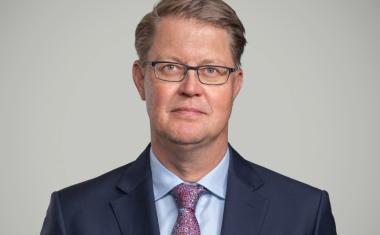
New Beginnings. Interview with Patrick Lacroix, Managing Director of Solvay Energy

The Solvay Group has recently announced the establishment of a new subsidiary, Solvay Energy. The Solvay Group has for years had a very proactive energy strategy which focuses on sustainable development, cost-efficiency and fuel diversification. CHEManager Europe asked Patrick Lacroix, Managing Director of Solvay Energy, about the role the new subsidiary will play within Solvay.
CHEManager Europe: What will be Solvay Energy's main responsibilities?
P. Lacroix: Solvay Energy will negotiate, conclude and manage the main contracts for natural gas, coal, coke, fuel, electrical energy, steam and carbon dioxide emission rights on behalf of the entities of the Solvay group.
Solvay Energy will also be implementing an energy hedging strategy in collaboration with the relevant strategic business units of the Solvay Group to protect their business against the wide price volatility that has been witnessed recently. For instance, in the last 18 months oil price has more than tripled from $40 to 140 per barrel before falling back below $40/bbl and is now hovering between $60 and $70 per barrel. We have witnessed the same kind of price swings in coal and other fuels. Managing swings of this magnitude is quite a challenge for any industrial company using a large amount of energy.
Will Solvay Energy carry out this role for all Solvay subsidiaries?
P. Lacroix: Yes, indeed. We expect an enhanced buying power by grouping energy contracts of Solvay subsidiaries.
How does the establishment of Solvay Energy fit into Solvay's global strategy?
P. Lacroix: Energy is an important part in Solvay's costs, representing in 2008 about 10 % of sales. The main purpose of Solvay Energy is to regroup experts and competences in one entity which enables to provide the Group's subsidiaries with energy price hedging. Centralizing and consolidating the expertise on energy markets as well as hedging capabilities within one single entity will ensure the Group is adequately positioned to react rapidly to evolving market conditions.
What were the deciding factors behind this decision? In other words, why now and not before?
P. Lacroix: The liberalization of the electricity and gas markets in Europe has been a big driver. As a result, we have seen new emerging energy market exchanges in continental Europe. The dynamics of these markets represent both a challenge and an opportunity for the Group, as response time to market fluctuations becomes more and more important. Solvay Energy will be targeting selected energy exchanges it deems representative and having sufficient liquidity as main reference for underlying contracts.
How will the subsidiary further enable Solvay to improve cost-efficiency?
P. Lacroix: Solvay Energy will improve cost-efficiency on the buy-side. Technical measures to improve cost-efficiency such as the construction of a combined cycle gas turbine in the Bahia Blanca plant are not in the scope of Solvay Energy and are managed by the technical teams.