Ma’aden Awards Phosphate Contract to Daelim
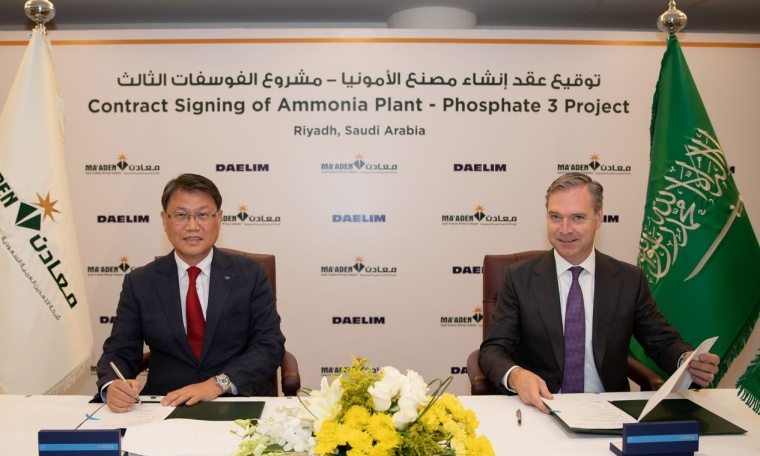
Saudi Arabian Mining Company (Ma’aden) has awarded an engineering, procurement and construction (EPC) contract to South Korea’s Daelim for the first plant to be built as part of its third large-scale phosphate complex at Ras Al-Khair on Saudi Arabia’s east coast.
Daelim Industrial and Saudi Daelim will jointly perform EPC services on the plant, which will produce 1.1 million t/y of ammonia. The project will take 38 months to implement.
The complex, known as Phosphate 3, will increase Ma’aden’s phosphate capacity by 3 million t/y to a total of 9 million t/y, making the Kingdom the world’s third-largest producer of phosphate fertilizer and the second-largest exporter.
Ma’aden said the overall project, which is expected to cost $6.4 billion, will be built in stages and phased in by 2024. It will generate non-oil GDP growth of $6.7 billion and create approximately 7,000 direct and indirect jobs.
Daelim recently provided EPC services on an ammonia plant for Ma’aden Waad Al-Shamal Phosphate Company, a joint venture between Ma’aden, SABIC and US fertilizer group Mosaic. The 1.1 million t/y ammonia facility, one of seven plants at the phosphate complex that is also located at Ras Al-Khair, started commercial production in 2017.