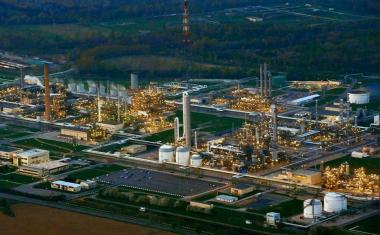
China's Sinopec to Build Big Oil Storage in Indonesia
China's Sinopec has started work to build Southeast Asia's largest oil storage terminal at Indonesia's Batam Free Trade Zone, industry sources said on Tuesday.
The first phase of the construction will be a 16 million barrel oil storage facility that will be built on a plot of land of about 80 hectares, at least one source familiar with the project details said.
About 360 hectares of land in Batam's Free Trade Zone has been set aside, with a refinery and petrochemical project being considered as part of the second phase of development, the source said.
Indonesian officials were not immediately available for comment.
"For the moment, the immediate priority is to get the storage facility built, the refining and petrochemical projects are not at the execution phase yet," the source said.
"This has been a project which they (Sinopec) had been thinking about for a while now... at least two years in the making, this project is on a cluster of islands where some reclamation has taken place."
Industry sources said the project was originally planned as a joint-venture between the Chinese refiner and OilTanking, a unit of the privately held Marquard & Bahls.
"The deal fell through after Oiltanking decided to go ahead to build a storage facility in Karimun (Indonesia), to be honest this came as a surprise," the source said.
"It's happened all very quickly and frankly we don't have all the details, we only received this invitation and that's as much as we know."
The invitation which was sent out to select industry executives, said Indonesian president, Susilo Bambang Yudhoyono would preside over the ground breaking ceremony which was slated to take place on Wednesday.
The new storage facility is likely to take anything between 18-24 months to construct, industry sources said. It will complement Singapore's position as the region's top trading hub.
Singapore, which is about three and half times the size of the U.S. capital, Washington D.C. has been struggling in recent years to cope with the expanding demand for oil storage in the region.
The reluctance of the Economic Development Board, its main agency for economic strategy, to free up more land to build oil storage facilities has triggered a series of oil infrastructure projects in southern Malaysia over the past 24 months.
In late 2011, commercial storage operator, Vopak, the world's largest independent oil storage operator, began construction of a terminal project at Pengerang, a seaside town at the southern tip of Malaysia's Johor state.
The 1.3 million cubic meter (cu m) facility, being developed with Malaysia's Dialog Group, is estimated to cost up to $700 million and be fully operational in 2014.
Earlier this year, Vitol, the world's largest independent oil trader, kicked off operations at its $290 million storage facility at Tanjong Bin in southwest Malaysia.