Bridging Speed and First-Time-Right Scale-Up
As pharma outsourcing accelerates, CDMOs must balance speed and quality across intermediates, KSMs, RSMs, and APIs—while First-Time-Right scale-up remains challenged by process gaps and technology transfer hurdles.

The pharmaceutical outsourcing landscape is evolving rapidly. Contract Development and Manufacturing Organizations (CDMOs) are expected to accelerate programs from laboratory development to clinical and commercial manufacturing while maintaining uncompromising standards of quality, safety, and regulatory compliance. Across a diverse portfolio spanning intermediates, KSMs, RSMs, and APIs, speed and quality has become an essential competitive differentiator. However, achieving First-Time-Right (FTR) scale-up remains a significant challenge due to limited process understanding, technology transfer gaps, equipment differences across scales, raw material variability, and insufficient analytical readiness. These factors can lead to process deviations, yield losses, prolonged troubleshooting, and out-of-specification (OOS) results.
The successful CDMO operations ensure that speed and quality are not opposing objectives, rather, both are achieved through a science-based development strategy that builds deep process understanding early and systematically transfers that knowledge throughout the product lifecycle.
Building an Integrated R&D Organization
In a CDMO environment, where projects differ significantly in maturity, complexity, and customer expectations, an R&D-driven organizational structure is one of the most powerful enablers of successful scale-up. Effective integration of Process R&D, Analytical R&D, Process Safety, Engineering, Pilot Plant, and Project Management creates a framework that enables faster decision-making, rapid problem-solving, clear ownership, and effective risk management throughout development and commercialization.
Development programs rarely progress in a linear manner, and organizations must be designed to respond quickly to evolving technical challenges that support rapid learning while maintaining quality and compliance at the core.
Moving Beyond Yield Optimization to Process Understanding
While yield remains important, robust scale-up of development programs requires a much deeper process understanding should include reaction kinetics, mixing sensitivity, heat and mass transfer characteristics, thermal behavior, crystallization mechanisms, impurity generation pathways, and process safety considerations. Understanding the scale-dependent effects early is critical to reducing risk during commercial implementation.
Design of Experiments (DoE) provides a structured approach to identifying critical process parameters and understanding operating ranges. Similarly, Process Analytical Technology (PAT) tools enable development teams to gain real-time insight into reaction kinetics and process dynamics. Together, these approaches help create robust processes capable of tolerating operational variability while consistently delivering quality and yield targets.
Designing for Scalability from Day One
One of the most effective strategies for achieving FTR scale-up is to incorporate manufacturing considerations throughout the development journey. Early involvement of process engineering teams allows to evaluate equipment fit, identify scale-dependent risks, conduct hazard assessments, and define appropriate control strategies.
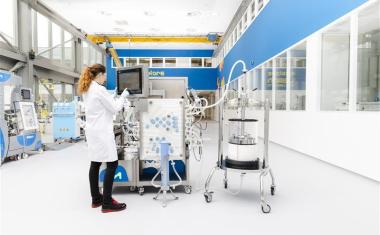
Particularly for downstream operations such as workup, filtration, drying, isolation, and solid handling, the use of miniature plant-equivalent equipment can provide valuable insight into potential scale-up challenges.
The Pilot Plant as a Learning Laboratory
The pilot plant serves as a critical bridge between laboratory development and commercial manufacturing. A well-designed pilot program functions as a learning laboratory where process assumptions are challenged, control strategies are tested, and equipment compatibility is assessed under manufacturing-relevant conditions. The first reactor-scale demonstration provides an invaluable opportunity to validate process understanding, evaluate reproducibility, and build confidence in product quality and yield performance.
Technology Transfer: Beyond Documentation
Establishing a robust and structured technology transfer process that emphasizes effective knowledge transfer and supported by comprehensive documentation, standardized checklists, and rigorous review mechanisms to ensure accuracy, compliance, and seamless execution. While documentation is essential, successful technology transfer also depends on transferring tacit process knowledge, including critical observations, troubleshooting experience, and process sensitivities. Furthermore, ensuring successful knowledge transfer must involve continuous handholding and technical support throughout the transfer journey to the manufacturing success.
Continuous Process Improvement
First-Time-Right manufacturing does not end with a successful scale-up campaign. Sustainable operational excellence requires continuous learning and process improvement throughout the commercial lifecycle. Post-campaign reviews, process performance trending and deviation analysis, identify opportunities to improve yield, reduce cycle times, enhance robustness, and strengthen process control.
Delivering Speed with Reliability
In today’s CDMO ecosystem, speed alone is not a competitive advantage. Sustainable success comes from combining scientific rigor, robust process understanding, and effective knowledge transfer throughout the product lifecycle.
As customer expectations continue to rise, the pharmaceutical industry increasingly values partners who can combine scientific rigor with operational excellence. At Cohance, the focus is not simply on moving faster, but on enabling faster learning, smoother technology transfer, and reliable commercial execution.