BASF Inaugurates TDI Plant at Ludwigshafen
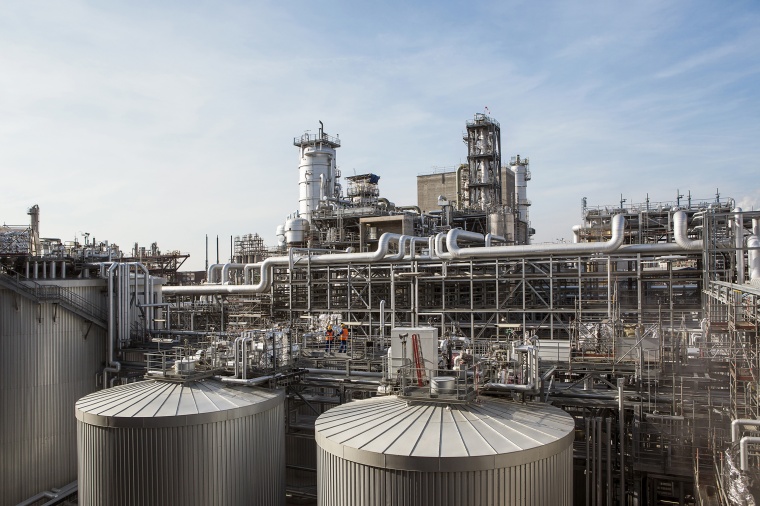
BASF inaugurated its new €1 billion TDI complex at Ludwigshafen on Nov. 16 at a ceremony attended by Germany’s vice chancellor, Sigmar Gabriel, and the prime minister of the state of Rhineland-Palatinate, Malu Dreyer. In addition to a 300,000 polymerization unit for the polyurethanes feedstock, the investment – largest ever in the German group’s history – includes a new hydrogen chloride recycling plant and expanded facilities for nitric acid, chlorine and synthesis gas as well as the TDI feedstocks dinitrotoluene (DNT) and toluylendiamine (TDA).
According to BASF, the world’s second largest TDI producer behind German rival Covestro – the former Bayer MaterialScience – start-up of the new TDI unit will increase output capability to 780,000 t/y. The 80,000 t/y unit at Schwarzheide in eastern Germany will be gradually ramped down and closed.
In future, BASF will have two production sites in Europe for the key polyurethane feedstocks – Ludwigshafen for TDI and Antwerp for MDI and propylene oxide (PO). At the latter site, the German group has capacity to produce 560,000 t/y of MDI as well as 300,000 t/y of PO as part of a joint venture.